
WISER.
The AI Operations methodology—the phased delivery model we run inside client businesses. Built on AI First Principles.
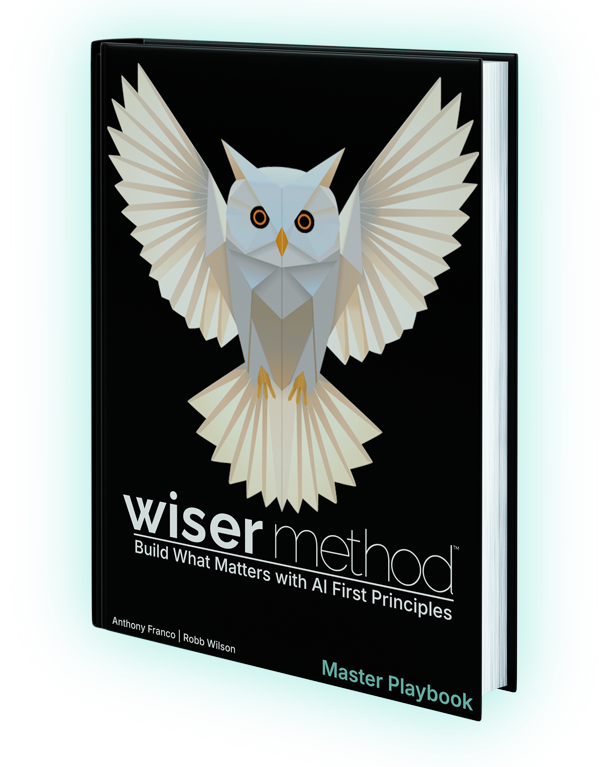
The full method in one place. Five canons. Twenty-six Plays. A full case-study narrative that walks one engagement end to end. Thirty-five downloadable templates the team uses in production.
Four capabilities.
A team running on WISER ends up with four things it did not have before.
-
Continuous evolution
Systems keep evolving while the business runs.
-
Systematic risk burn-down
Risk gets reduced through evidence, one item at a time.
-
Living documentation
A Playbook that captures every outcome and stops the institutional forgetting.
-
Clear ownership
Every decision has a named person, even when AI does the work.
When stagnation is the bigger risk.
WISER is built for one kind of team: the one where standing still costs more than moving. The team holding onto systems competitors are already replacing. The team where leadership knows the dysfunction is daily, but every change carries political risk. The team that watches opportunities pass because committing to a direction feels too dangerous.
AI can break that pattern, but not if you bolt it onto broken processes. That just scales the mess. Real change requires dismantling the bureaucracy underneath, not automating it.
The distance between knowing what you want AI to do and getting it running inside your business is not a tooling gap. It is a methodology gap.
Three axioms.
The method runs on three axioms. Each one is an operator stance, not a slogan.
-
Action over theory.
Trust what works in practice, not what works on paper.
-
Evolution over disruption.
Rebuild while the business runs. No stop-and-rewrite.
-
People over proxies.
The operators doing the work outrank the people writing about it.
These hold across every engagement.
Disciplined momentum.
The engine of the method is risk reduction by evidence. Start with what is most likely to fail. Test it. Reduce the failure mode through small, bounded changes. Then move to the next risk.
Bounded changes have a useful side effect: they show how the system actually behaves under operating conditions. What works expands. What does not gets reworked. Decisions made on real evidence drive the next action. Each action grows capability. New capability frames new decisions. The loop is self-feeding once the structure exists to keep it from running off the rails.
The discipline of running AI systems in production at this cadence is what WISER calls AI Operations: the methodology, the accountability structure, the feedback loops, and the governance that keep production AI from drifting, breaking, or quietly going wrong.
The five canons.
The canons run in order: Witness, then Interrogate, Solve, Expand, Refine. The sequence is logical but not rigid. Insights found in Expand can send you back to Interrogate. Iteration is the design, not a sign of failure. Each canon draws on a specific subset of AI First Principles.
Documentation describes the work. Observation shows it.
PrinciplesBuild from User Experience. Reveal the Invisible. Discovery Before Disruption. Deception Destroys Trust.
Observation locates the pain. Experiments diagnose it.
PrinciplesIterate Towards What Works. Reveal the Invisible. Build from User Experience. AI Inherits Messiness. Ambiguity Is Wisdom. Deception Destroys Trust.
Experiments isolate causes. Working solutions build trust.
PrinciplesIterate Towards What Works. Reveal the Invisible. Build from User Experience. Justify Resource Consumption. People Own Objectives. Deception Destroys Trust.
Trust built in one place becomes the basis for autonomy in many.
PrinciplesDecompose Incrementally. Reveal the Invisible. Build from User Experience. Justify Resource Consumption. AI Fails Silently. People Own Objectives. Deception Destroys Trust.
Autonomy is grown, not specified.
PrinciplesAI Inherits Messiness. Reveal the Invisible. Build from User Experience. Justify Resource Consumption. Decompose Incrementally. AI Fails Silently. Deception Destroys Trust.
For the operator-narrative version of each canon (what we do during the phase), see How We Work.
For the twelve principles in full, see AI First Principles.
Plays, Playbooks, Positions.
Three more structural elements complete the methodology.
-
Plays
turn the canons into something a team can actually use. Each Play is a tactical pattern shaped for a specific situation: an industry (manufacturing, financial services, healthcare), a company stage (startup, enterprise, regulated), or a generic pattern that fits broadly. A team does not follow a Play; they adapt one. The Play is the starting point.
-
The Playbook
is where the work remembers itself. Every outcome gets recorded. Every adjustment gets logged. Every hard lesson gets written down. What worked once becomes the new default. What failed becomes the warning that keeps the next team from repeating it. The Playbook guiding tomorrow's decision carries the full history of yesterday's.
-
Positions
name accountability. Nine of them: Authority, Empathy, Translation, Context, Skepticism, Execution, Safety, Stewardship, Integrity. Each Position owns a specific kind of decision. Small teams compress multiple Positions into one person. Larger teams distribute them across specialists.